
Last updated October 30, 2026
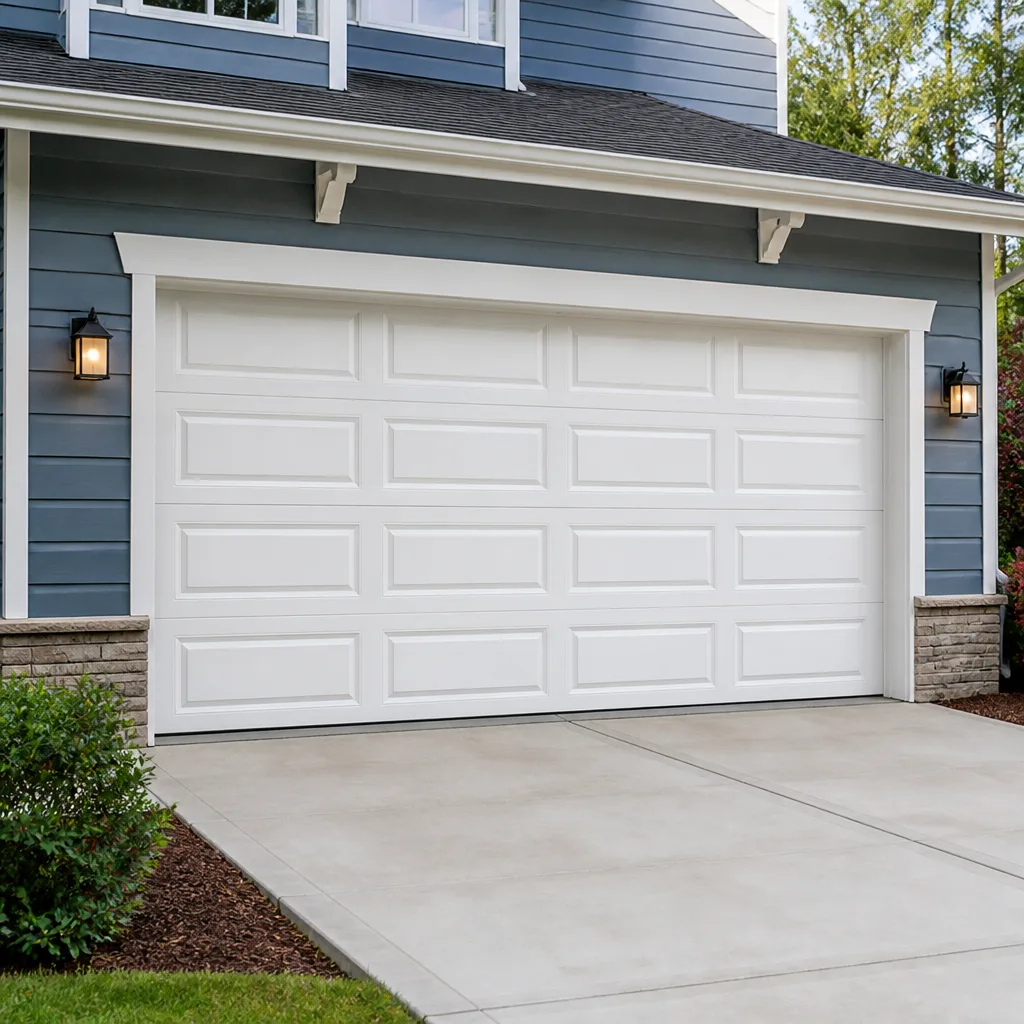 Raised-panel steel
 Carriage house
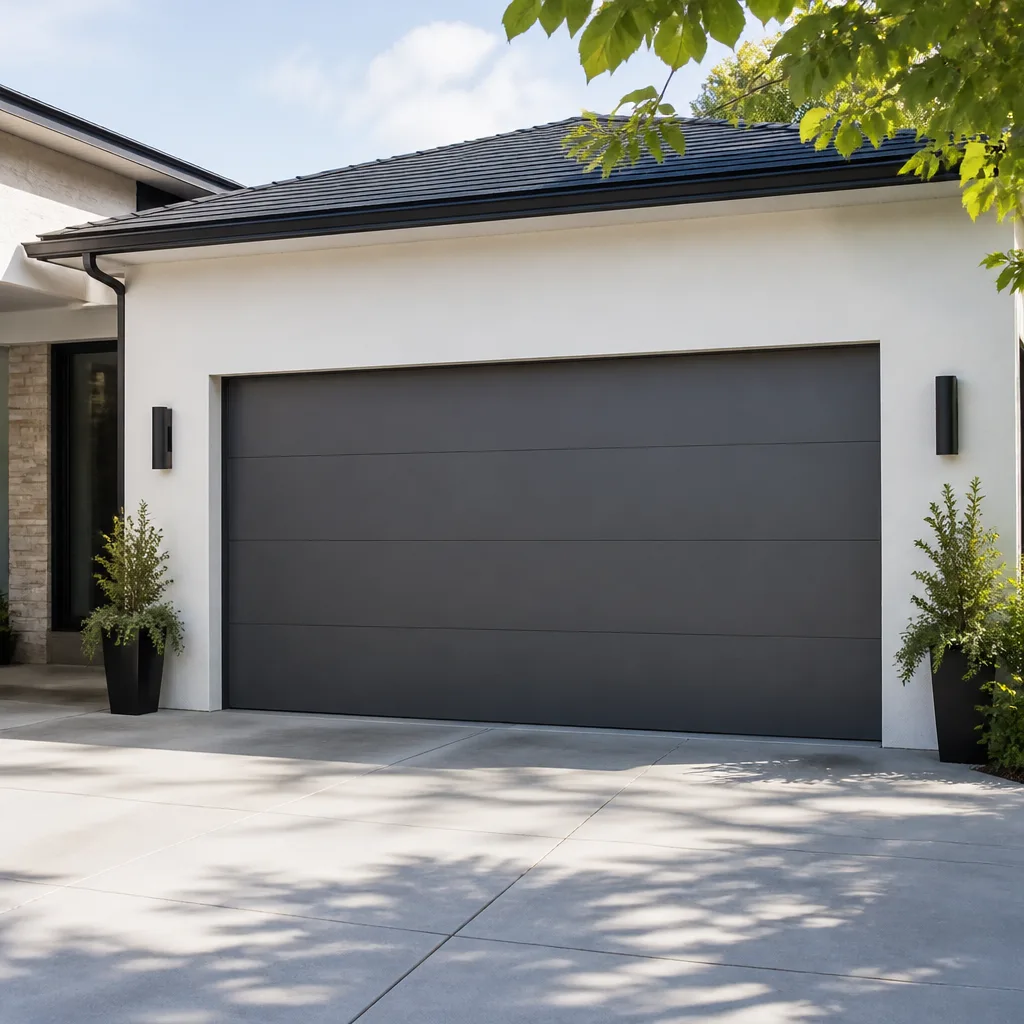 Modern flush
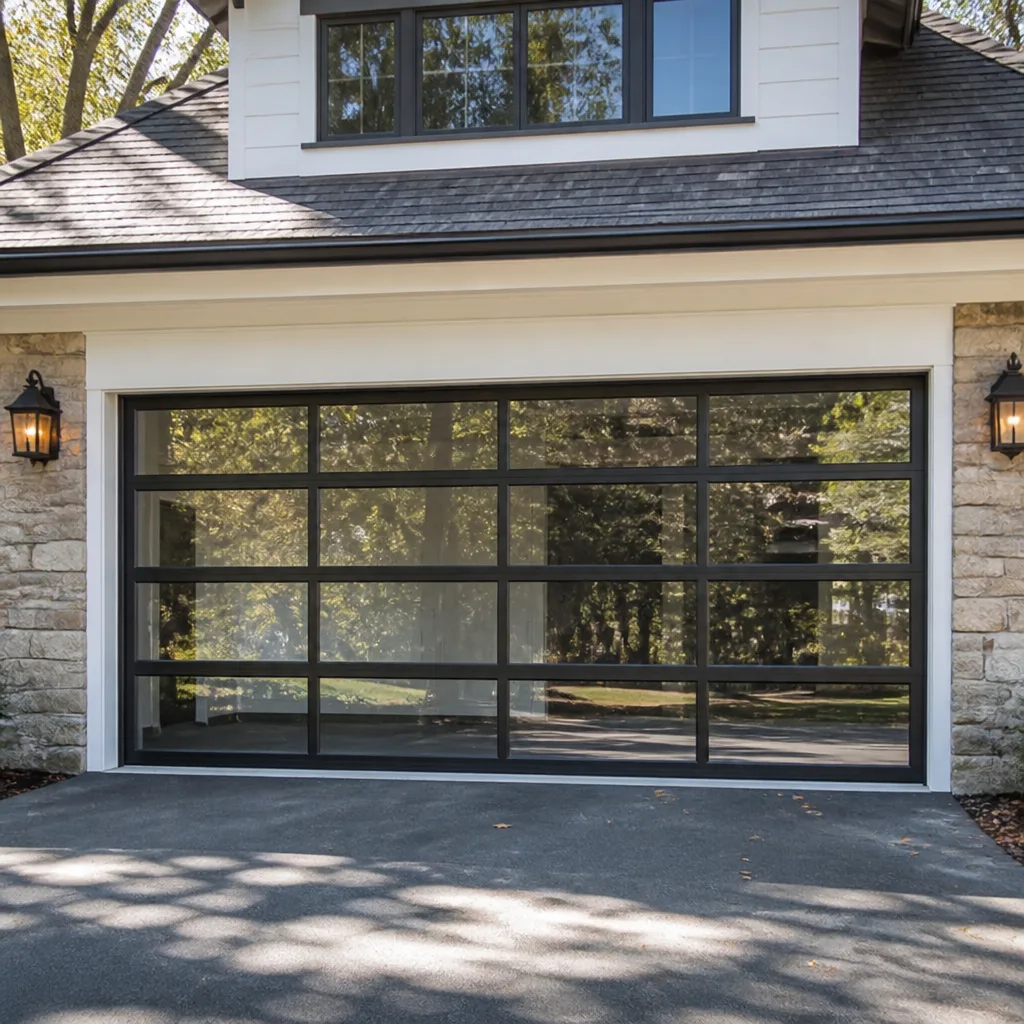 Full-view glass
 LiftMaster openers
 Chamberlain openers
Full 25-point door and opener safety check with every visit - springs, cables, rollers, tracks, and your LiftMaster or Chamberlain opener included
You get a price before we start. It does not change when the truck arrives.
Get your free estimateGarage Door Warning Signs: A Ontario Homeowner’s Reference Guide
Here’s a counterintuitive fact we’ve learned from hundreds of service calls across Ontario: your garage door talks to you for weeks, sometimes months, before it actually fails. The problem is that most homeowners don’t speak the language. A door that shudders on the way up, a cable that looks slightly frayed, a noise that’s been present so long it’s become background sound. These are mechanical tells. Specific components announce their impending failure in specific ways, and learning to read those signals is the difference between a $200 repair and a $900 emergency replacement. This guide decodes what your door is actually saying, so when you call a garage door repair service in Ontario, you can describe the problem accurately and get it fixed correctly the first time.
Quick Answer
Garage door warning signs fall into four categories: sounds (grinding, popping, squealing), movement irregularities (stalling, shaking, slowing on one side), visual damage (frayed cables, gaps in springs, bent panels), and opener behavior (reversing, running without moving the door). Each sign points to a specific failing component with a different urgency level. In Ontario, where summer heat cycles stress metal components on a daily basis, catching these signs early typically means a repair under $300 instead of a full replacement over $1,200.
Styles & brands we work with
Table of Contents
- The Sound Diagnostic: What Your Door Is Trying to Tell You
- The Reversing Door: Why It’s Almost Never the Opener
- When One Side Moves Slower: Cables, Drums, and Tracks
- The Halfway Stop: What a Stalling Door Actually Means
- Visual Inspection: Springs and Cables You Can Check Without Touching
- Cosmetic Dent vs. Structural Compromise: Knowing the Difference
- Opener Warning Signs: When the Brain of the System Is Failing
- Common Mistakes to Avoid
- When to Call a Professional
- Frequently Asked Questions
The Sound Diagnostic: What Your Door Is Trying to Tell You
A garage door in good working order is not silent, but it’s consistent. You hear the opener motor, the rollers moving along the track, and a soft thump when the door settles. When a new sound appears, or an existing sound changes character, that’s your diagnostic starting point. In Ontario’s climate, where daily temperature swings of 30 degrees or more are common from spring through fall, metal components expand and contract constantly. This makes sound an even more reliable early indicator here than in coastal areas with stable temperatures.
Here’s what the three most common sounds mean mechanically:
- Grinding: A metallic grinding sound usually comes from the rollers or the hinges. Rollers wear out, especially in older Ontario homes where original equipment may be 15 to 20 years old. When the bearings inside a roller fail, the wheel stops rolling smoothly and starts scraping against the track. Grinding also occurs when the track itself is misaligned enough that the roller rubs against it at a specific point in the travel. This is a moderate-urgency issue. Left unaddressed, a grinding roller can chew up a track section, which turns a $25 roller replacement into a $150 track replacement.
- Popping: A sharp popping sound, especially from the spring area, is serious. Torsion springs, the ones mounted on a horizontal bar above the door opening, build up enormous tension. When a spring is close to failure, individual coils can snap or slip, producing a pop. If your door pops during operation, stop using it and call for service. A snapped torsion spring releases that stored energy instantly, and while modern springs have safety containment cables, an unexpected failure can still damage the door, the opener, or anything in the way. In Ontario, we see a cluster of spring failures every summer, because heat speeds up metal fatigue in springs that are already near the end of their life cycle, typically 10,000 to 15,000 cycles.
- Squealing: A high-pitched squeal is nearly always a lubrication issue or a worn bearing. It’s the least urgent of the three sounds, but it shouldn’t be ignored. When metal parts run dry, friction builds heat, and heat accelerates wear. A door that squeals every time it opens is telling you that a component is working harder than it should be. In many cases, particularly with doors from Amarr or Wayne Dalton that have been in service for a decade or more, the squeal is coming from a roller bearing that’s lost its internal grease and is effectively running metal-on-metal.
The takeaway: sounds are diagnostic. A grinding roller and a popping spring are not equivalent problems, even though both are “noises.” Knowing which one you’re hearing helps you describe it accurately to whoever you call, and that description shapes how quickly you get the right fix.
The Reversing Door: Why It’s Almost Never the Opener
A door that reverses for no apparent reason, meaning it starts closing and then goes back up without any visible obstruction, is one of the most commonly misdiagnosed problems in the garage door industry. Homeowners call us thinking the opener is failing. In reality, the opener is usually doing exactly what it was designed to do: it’s hitting a resistance threshold and reversing as a safety response. The root cause is almost always a balance problem that’s been developing for months.
Here’s what’s happening mechanically. A properly balanced garage door should be liftable by hand with minimal effort, roughly 8 to 10 pounds of force, and it should stay in place when released halfway up. This balance is maintained by the springs, which are calibrated to offset the door’s weight. When springs age, they lose tension. As tension decreases, the door effectively gets heavier from the opener’s perspective. The opener’s motor has a force sensor, and when it encounters more resistance than it’s programmed to handle, it reverses. This is a safety feature, not a malfunction.
The diagnostic clue is this: if your door reverses only when closing, and especially if it reverses at roughly the same point in its travel each time, the springs are the likely culprit. If the opener itself were failing, you’d typically see inconsistent behavior, not a repeatable pattern. Another tell: disconnect the opener using the emergency release cord and try lifting the door manually. If it feels heavy, or if it drops when you let go, the balance is off. This is a test any Ontario homeowner can do safely, as long as you’re not touching the springs or cables directly.
The fix for a reversing door is rarely an opener replacement. In most cases, it’s a spring adjustment or replacement. This is also where calling a company with multi-brand experience matters, because spring specifications vary between manufacturers. A door from Clopay uses different spring rates than a door from Craftsman, even if both are the same size. At Cobblestone, we work on systems from eight major brands, including Amarr, Wayne Dalton, Craftsman, and Raynor, so the spring on your specific door is a known quantity, not a guess.
When One Side Moves Slower: Cables, Drums, and Tracks
If you watch your door operate and notice that one side lags behind the other, even by a small amount, pay attention. This is a specific failure signal that points to the cable and drum system, not the track, and the distinction matters because it changes the repair entirely.
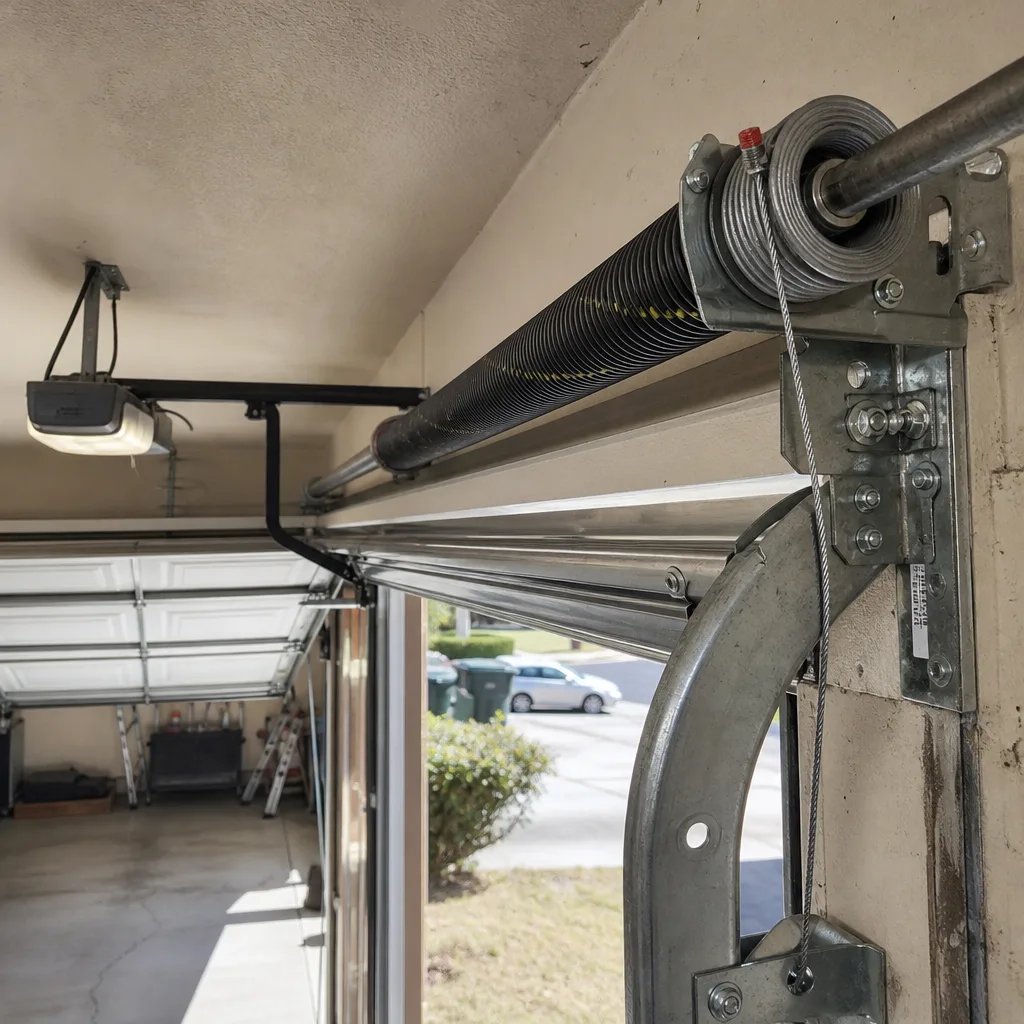
Here’s the mechanical explanation. Garage doors are lifted by cables on both sides. Each cable is wound around a drum, and those drums are connected to the torsion spring shaft. When the shaft rotates, both drums should turn at the same speed, feeding cable in and out at identical rates. If one drum is worn, or if one cable has slipped off its drum and re-seated incorrectly, that side of the door gets lifted at a different rate. The result is a door that appears to crawl up one side of the track while the other side moves normally.
Why this isn’t a track problem: a bent or misaligned track causes resistance, which typically manifests as a door that binds or sticks at a specific point, not a consistent speed difference across the entire travel. If the speed difference is present from the moment the door starts moving, the issue is in the cable, drum, or spring shaft. If the door only binds at one spot, that’s more likely a track issue.
The urgency on this one is high. A door moving unevenly is a door that’s putting asymmetrical stress on every other component, including the hinges, the panels, and the opener itself. Left unaddressed, an uneven door in Ontario, where many homes have attached garages with living space above them, can cause panel cracking, hinge failure, and in the worst case, a cable that snaps while the door is mid-travel. A snapped cable on an unbalanced door doesn’t always drop the door straight down, but it can, and a falling door panel section weighs more than most people realize.
The correct repair sequence is to inspect both cables and drums, verify the spring shaft is true, and re-balance the door. This is not a job for a visual inspection alone. It requires pulling the door through its full travel while observing how each drum feeds cable. If you’re seeing one side move slower, call for a garage door repair in Ontario and tell the technician exactly what you’re observing. It’ll save diagnostic time.
The Halfway Stop: What a Stalling Door Actually Means
When a door consistently stalls at the same point in its travel, that’s one of the most useful diagnostic patterns you can report. It eliminates a huge number of possibilities and points directly at a few specific culprits. In our experience across Ontario, the halfway stop is one of the warning signs we hear described most often, and it’s almost always one of three things.
First, the most common cause: a worn or misaligned track section. If the stall happens at the same physical point every time, and that point corresponds to a visible bend, dent, or gap in the track, you’ve found the answer. Rollers need clearance to travel, and a track that narrows or kinks at one spot will stop a door cold. The door may reverse or just sit there, depending on the opener’s force settings.
Second: a broken or failing roller. When a roller bearing seizes, the wheel stops turning and starts sliding. That sliding creates friction, and if the roller is at the point where the track curves from vertical to horizontal, the added resistance can be enough to stall the door. This point is about halfway through the travel on most setups, which is why it gets misdiagnosed as a track problem. A seized roller is usually visible, it won’t spin freely when the door is down and you can access it, but this requires reaching into the track area. If you’re not comfortable doing that, describe what you’re seeing and let a professional take it from there.
Third, and most serious: spring fatigue that has progressed to the point where the door’s effective weight exceeds what the springs can counter. Unlike the reversing door scenario, where the opener’s force sensor triggers a reversal, a heavily fatigued spring set can cause the door to stop partway and stay there, especially if the opener is older or has its force settings dialed down. This is the most dangerous version of the halfway stop, because it means the springs are close to the end of their functional life, and they’re not going to get better on their own.
The diagnostic step is simple: when the door stalls, disconnect the opener using the red emergency release and try to move the door manually. If it moves freely by hand, the issue is in the opener. If it’s heavy, binding, or won’t hold position, the issue is mechanical. This test takes two minutes and tells you which service line you need.
Visual Inspection: Springs and Cables You Can Check Without Touching
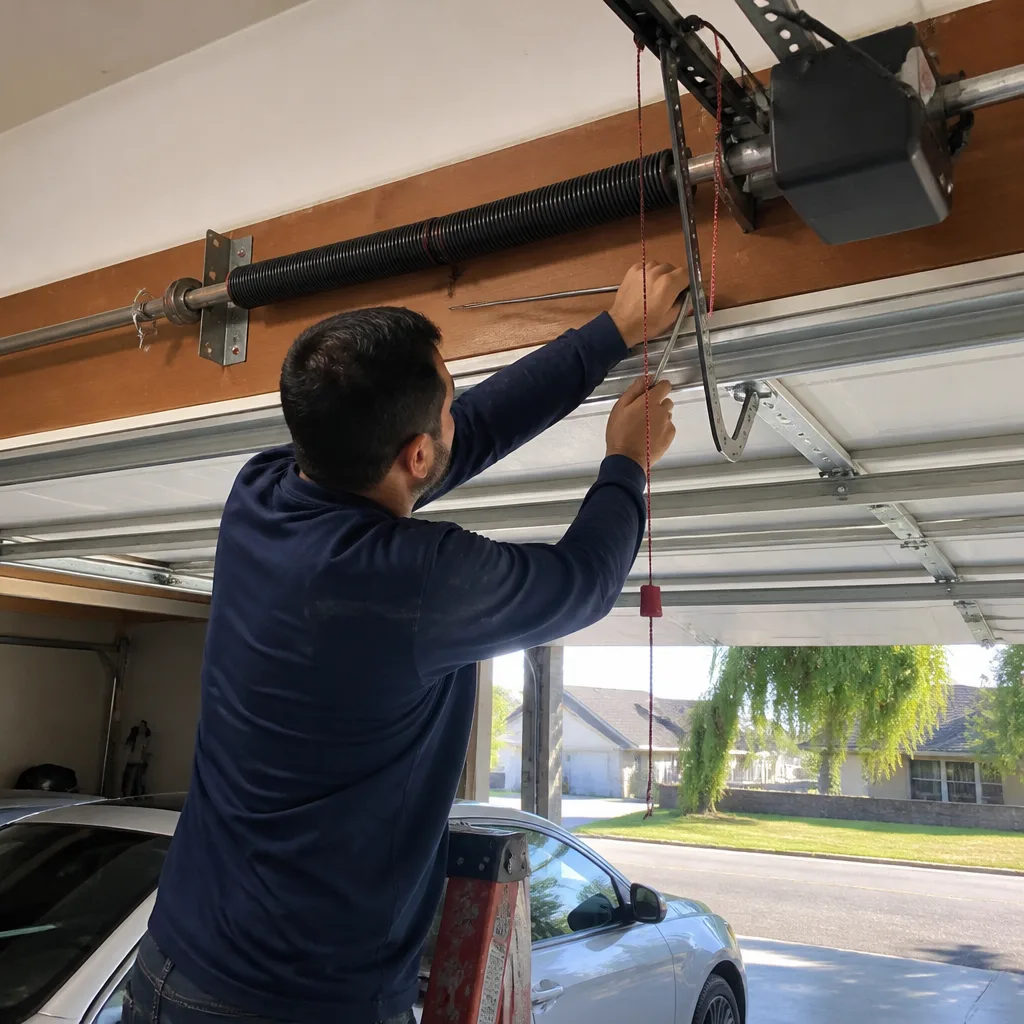
You don’t need to touch any hardware to perform a meaningful visual inspection. In fact, you shouldn’t touch the springs or cables at all, for any reason. Torsion springs carry stored energy, and a cable under tension can cut through a work glove if it slips. What you can do is look, and there are specific visual indicators that signal imminent failure with enough advance warning to schedule a repair before an emergency.
Here’s what to look for on the springs:
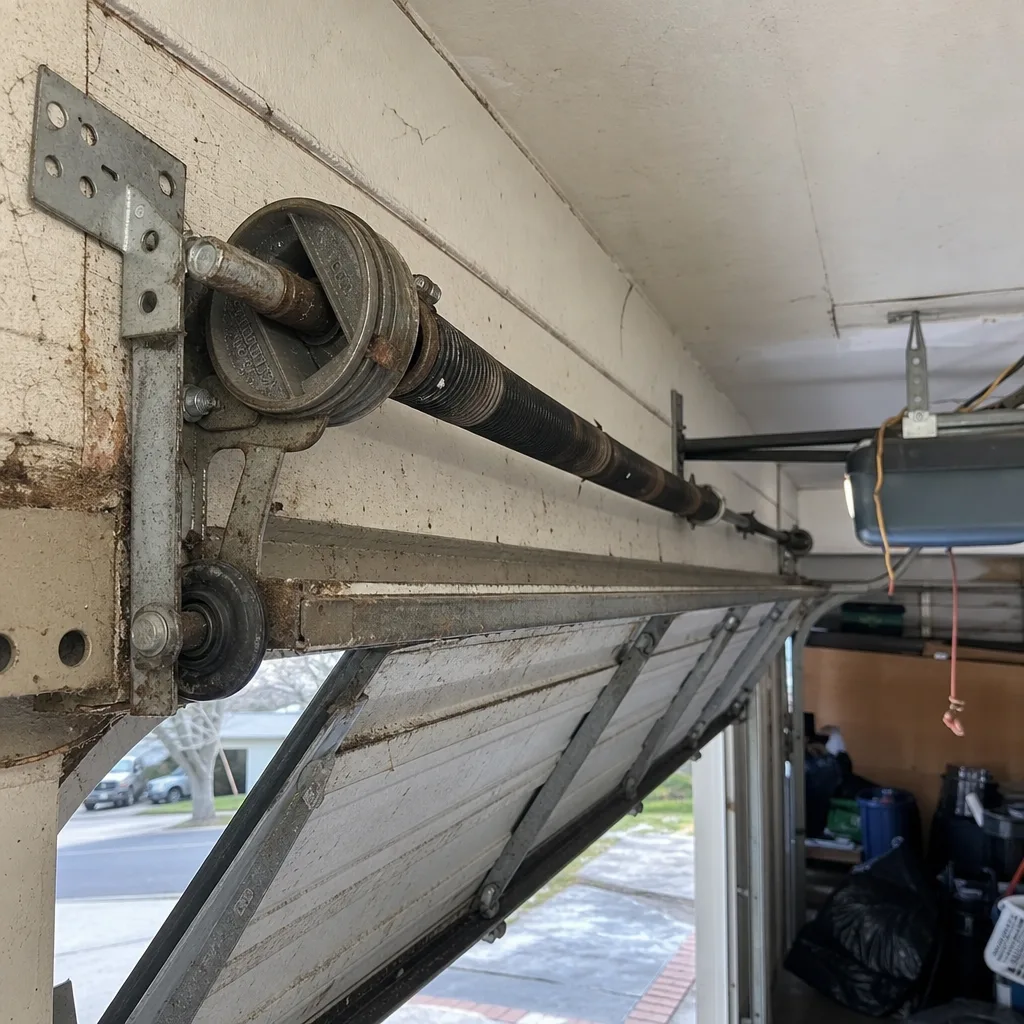
- The gap test: A healthy torsion spring has coils that sit tight together. As a spring approaches failure, you’ll see a visible gap open up between coils, often near the center of the spring. If you can see daylight between coils where there wasn’t any before, that spring is actively failing. This is the single most reliable visual indicator of spring fatigue.
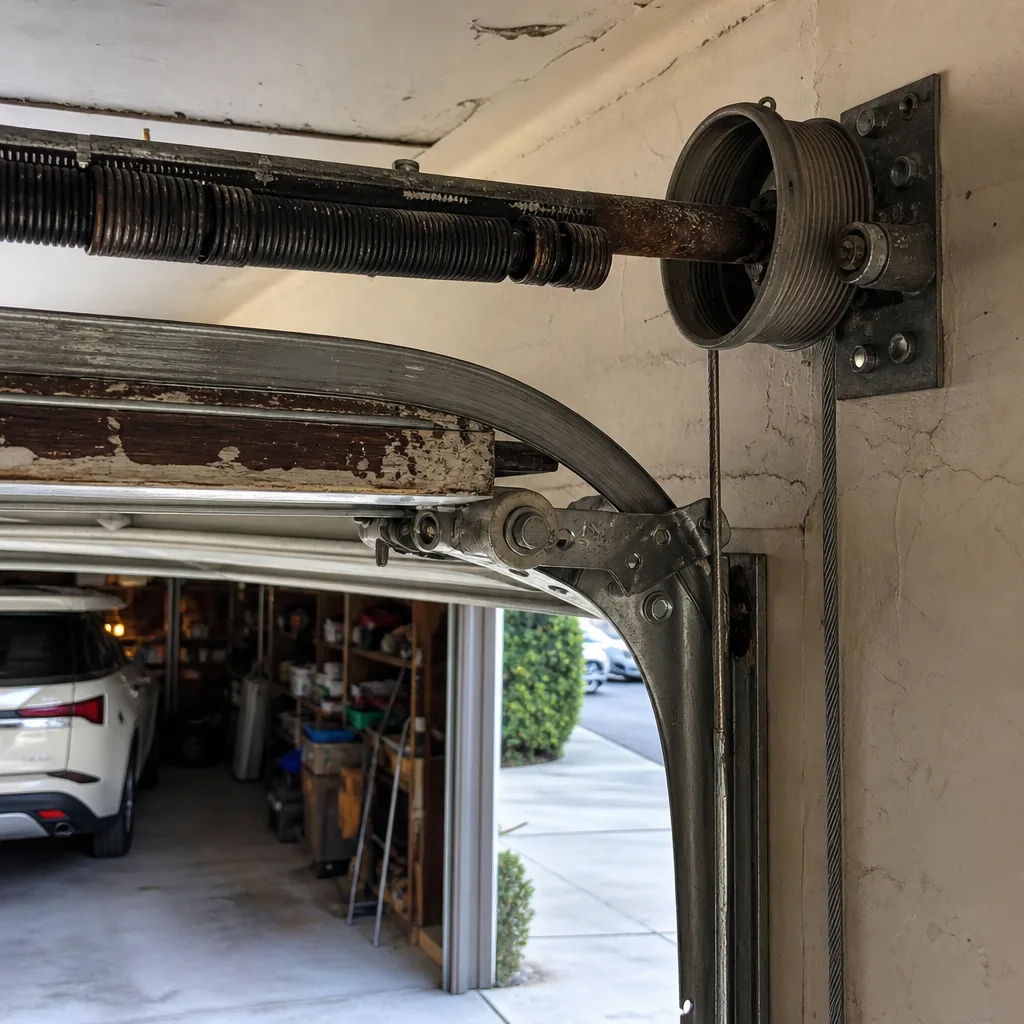
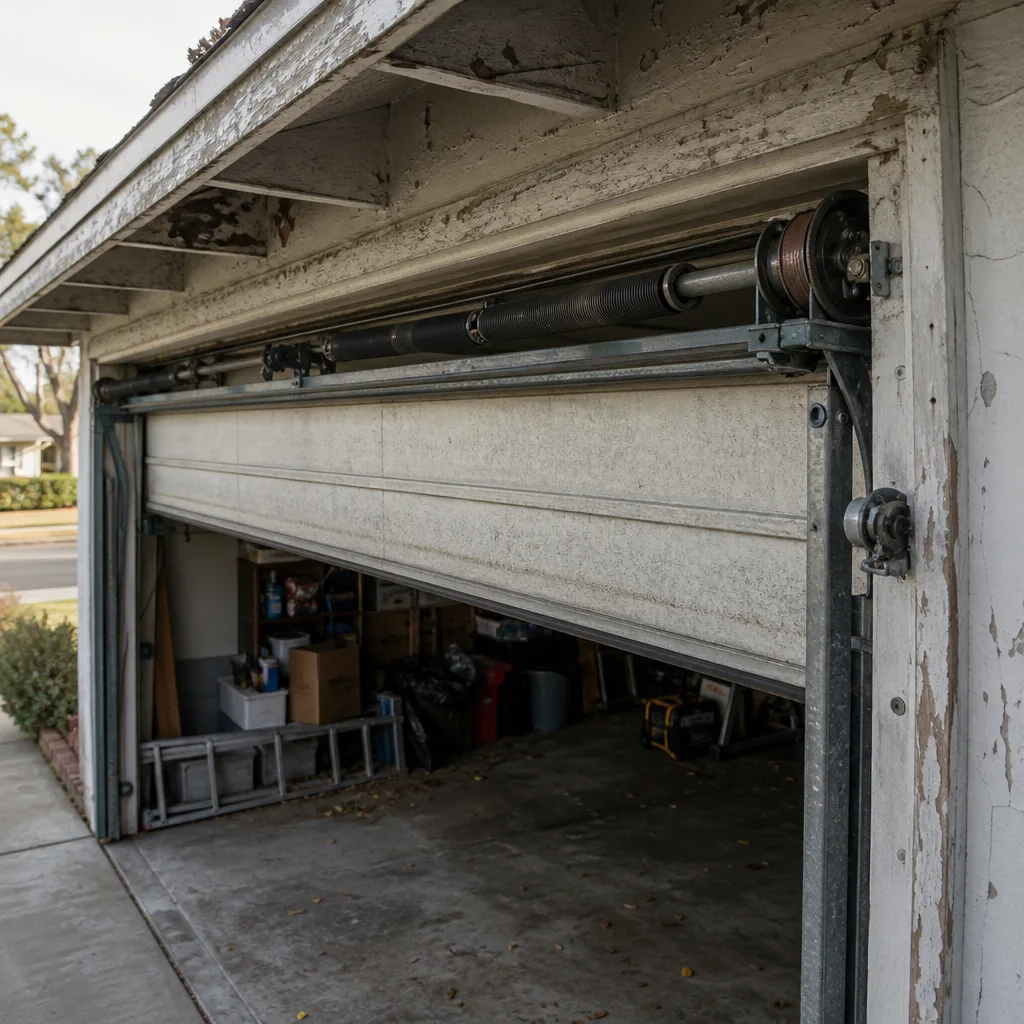
- The rust factor: Surface rust on a spring isn’t necessarily fatal, but deep rust that has pitted the metal changes the equation. Rust creates stress risers, points where the metal is microscopically thinner than the surrounding area, and those points concentrate force. In Ontario’s climate, where we get both desert-dry summers and periodic moisture from winter rains, springs that live outdoors or in unsealed garage spaces can develop this pitting within a few years. If your springs look deeply rusted, plan for replacement, don’t wait for the failure.
- Uneven wear: In a two-spring system, both springs should show roughly equal wear. If one spring has a visible gap or heavy rust while the other looks fine, the worn spring is carrying less of the load, which means the other spring is doing more work than it was designed for. This accelerates the failure of the healthier spring. Uneven wear is a replace-both-now signal.
On the cables, the visual tells are different:
- Fraying: Garage door cables are made of multiple steel strands twisted together. When individual strands begin to break, you’ll see small wires poking out from the cable body, especially near the drum or the bottom bracket. A frayed cable is a failed cable waiting to happen. The remaining strands are carrying more load than they’re rated for, and they fail quickly once fraying starts.
- Rust or corrosion: Like springs, cables degrade faster in climates with moisture swings. A cable that shows uniform light rust may still be serviceable, but heavy corrosion that has thinned the cable diameter is a replacement indicator. Check particularly where the cable meets the drum and where it attaches to the bottom bracket, these are the highest-stress points.
- Slack: When the door is fully closed, both cables should be taut. If one cable is visibly looser than the other, it may have slipped on the drum, which changes the door’s balance and puts uneven load on everything else. This is worth investigating, even if the door still operates.
The important framing here: you’re looking for changes, not absolute conditions. A door that’s been in service for years will show some wear. What matters is whether the wear is progressing and whether it has reached a point where the component is no longer doing its job. If you’re not sure, call and describe what you see. A garage door repair in Ontario that knows what it’s looking at can tell you whether you’re looking at years of remaining life or weeks.
Cosmetic Dent vs. Structural Compromise: Knowing the Difference
Not every dent is a problem, and not every straight-looking panel is healthy. This is one of the areas where homeowner intuition leads people astray. A dent isn’t a structural issue by definition. A panel can look dented but retain its full structural integrity, while another panel can look perfectly straight from the outside but be compromised underneath.
Here’s the distinction that matters. Garage door panels are engineered to span a specific distance and carry a specific load. They’re typically made of steel, 24-gauge or 25-gauge at the thinner end, 20-gauge or better on higher-quality doors from manufacturers like Clopay, Amarr, and Wayne Dalton. The structural role of a panel is to carry its own weight and transfer load to the hinges and tracks without flexing. When a panel loses rigidity, through corrosion, through a blow that bent the internal stiffening structure rather than just denting the surface steel, or through repeated stress from an unbalanced door, it stops doing that job properly.
How to assess without tools:
- Check the corners: A structural panel compromise often shows up first at the corners, where the panel meets the track. If a corner is pulling away from the track, or if the panel edge is visibly deformed, that’s not cosmetic. That’s a panel that’s losing its connection to the rest of the system.
- Press on the panel: With the door closed, place a flat hand on the center of the panel and push gently. A panel with intact structure should deflect very little, maybe a quarter inch. If it flexes noticeably, or if you can hear oil-canning, that metallic popping sound when thin steel flexes, the panel’s rigidity is compromised. It may be carrying a hidden crack in the internal structure.
- Look for cracking around hinges: If you see hairline cracks in the panel surface radiating from the hinge attachment points, that’s structural stress, not surface wear. These cracks mean the panel is flexing around its mounting hardware, and that flexing will get worse every cycle.
Why this matters in practical terms: a door with a structurally compromised panel doesn’t hang straight, which accelerates roller wear, puts uneven load on the springs, and eventually damages the track. In Ontario, where many homes have double-wide doors in attached garages, a compromised panel on a 16-foot door is a bigger problem than the same issue on a single-car door, because the wider span increases the load on every attachment point.
If you have a dent that’s just a dent, no cracks, no flex, corners intact, it’s likely cosmetic, and you can live with it as long as you like. If you see any of the structural indicators, address it sooner rather than later. A panel replacement is cheaper than a full door, and it’s dramatically cheaper than the cascade of failures a compromised panel eventually causes.
Opener Warning Signs: When the Brain of the System Is Failing
Your opener is the brain of the system. It’s the component that orchestrates everything else, and like any complex piece of equipment, it has its own set of failure signals. In Ontario, where many homes still have openers that were installed with the house 15 or 20 years ago, opener-specific warning signs are becoming more common.
The first and most clear-cut sign: the opener runs but the door doesn’t move. This is a specific failure mode that usually points to a broken gear inside the opener, a failed sprocket, or a worn belt or chain. The motor is spinning, but the mechanical connection between the motor and the door has broken. This is an opener repair situation, and it’s one where the brand matters. A LiftMaster uses a different internal architecture than a Chamberlain or a Genie, even within the same parent company, and the repair approach varies. At Cobblestone, we work on openers from eight major brands, so there’s no opener we’re not set up to diagnose.
Second: the opener reverses immediately after closing, which is different from the mid-travel reversal we covered earlier. When the door goes down, touches the ground, and immediately reverses back up, that’s usually a limit-switch problem. The opener’s internal switch that tells it “you’ve reached the floor” is out of adjustment, so the opener thinks it hit an obstacle and reverses as a safety response. This is a relatively simple fix on most openers, a limit adjustment, but it’s also a sign that the opener may need a broader service. Limit switches don’t usually drift on their own, something has worn, shifted, or loosened.
Third: the opener is getting louder over time. An opener that has become noticeably noisy in the last year is communicating wear. The drive mechanism, whether belt, chain, or screw, has components that wear with use. A chain that’s stretched, a belt that’s cracking, a screw drive that’s losing its lubricant layer, these all increase operating noise and also increase the load on the motor. This is the opener equivalent of a worn roller, not an emergency, but a signal that service is due.
Fourth: intermittent operation. If the opener sometimes works and sometimes doesn’t, especially if the failure seems related to weather, that’s often a logic-board problem. Extreme heat, which Ontario gets plenty of in July and August, can expose solder joints that are failing. The board heats up, a microcrack expands, the connection breaks, and the opener stops responding until it cools down. This is one of the most frustrating failure modes for homeowners because it never seems to happen when a technician is watching. If you’re seeing intermittent behavior, describe the pattern: when it fails, what the temperature was, how long it was out, what made it work again. That pattern is diagnostic.
The opener is also where smart-home integration lives. If your door works fine from the wall button but won’t respond to the app, or if the app reports the door is open when it’s closed, that’s not a door problem. That’s an opener-brain problem, and it typically requires someone who understands both the mechanical side and the electronics side. That’s why opener repair is a standalone specialty at Cobblestone Garage Door Repair home, not an add-on to spring work.
Common Mistakes to Avoid
- Lubricating a grinding component without diagnosing it first. If a roller bearing has failed, adding lubricant masks the sound briefly and lets the underlying problem progress. The grinding comes back louder, and by then the track may be damaged. Diagnose first, then lubricate or replace.
- Continuing to operate a door that pops or shudders. A popping spring is warning you of imminent failure. Every additional cycle brings that failure closer. When a torsion spring snaps under load, it can damage panels, the opener, or anything stored near the door. In Ontario, where garages often double as storage and workshop space, that’s a real risk.
- Adjusting the opener’s force settings to “fix” a reversing door. The reversing door we described earlier is a balance problem, not a force-setting problem. Cranking up the force dial overrides the safety mechanism and masks the real issue. You end up with a door that closes, but a spring that’s getting worse, and eventually the door doesn’t stay up at all.
- Replacing the opener before checking the balance. If your door reverses, and the problem is the springs, a new opener won’t fix it. The new opener will reverse too, because the balance problem is still there. This is an expensive mistake that happens more often than it should. Disconnect the opener and test the door by hand before spending a dime on opener work.
- Ignoring rust on springs because “it hasn’t broken yet.” Rust doesn’t cause failure by itself, but it’s the most visible indicator that a spring is aging faster than it should be. Deep pitting on a spring in a Ontario garage is a replace-soon signal, not a keep-an-eye-on-it signal.
- Assuming every dent is harmless. A structural panel compromise can hide under a straight-looking surface. If a panel flexes when you press on it, or if cracks appear around the hinge mounts, the panel’s job is done, even if a casual glance says otherwise.
When to Call a Professional
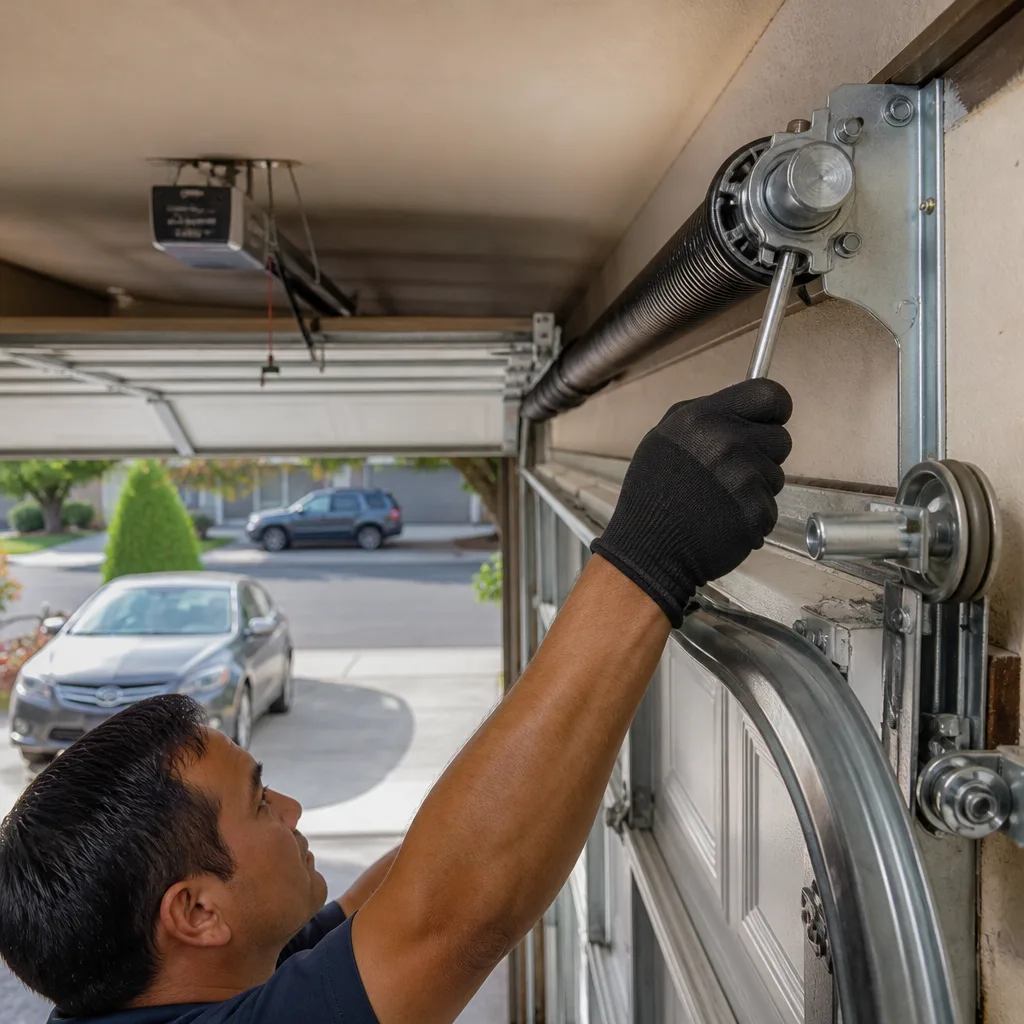
Some garage door issues are safe to diagnose from a distance. Some are not. Springs and cables are the two components where a professional is non-negotiable. They carry stored energy that can cause serious injury if mishandled, and neither one is a DIY repair. If your spring has a visible gap, if your cable is frayed, if your door is moving unevenly, stop using the door and call for service. The same applies to any job that requires working with a ladder near the shaft or the cable drums. A garage door installation in Ontario is also professional work, but for this guide, the focus is on repair. If you’re seeing any of the warning signs we’ve covered, Cobblestone Garage Door Repair offers free estimates in Ontario. Call (866) 667-5857 and describe what you’re seeing. We’ll tell you what’s actually wrong, not what gets our truck there fastest.
Frequently Asked Questions
Most torsion springs are rated for 10,000 to 15,000 cycles, which translates to roughly 8 to 12 years of normal use, but Ontario’s heat cycles can accelerate metal fatigue, especially on springs that are dry, rusty, or on doors that are used heavily. If your springs are over 10 years old and showing any visual wear, plan for replacement proactively.
No. A popping sound from the spring area indicates the spring is close to failure, and continuing to operate the door increases the risk of a snap while the door is in motion. Stop using the door and call (866) 667-5857 to have it inspected before it becomes a bigger problem.
A door that reverses without a visible obstruction is usually hitting the opener’s force threshold because the springs are no longer properly counterbalancing the door’s weight. The opener is doing what it should, reversing when it senses resistance. The fix is a spring adjustment or replacement, not an opener replacement.
Spring replacement in Ontario typically falls between $180 and $340 for a standard double-door setup, depending on the spring type, size, and the door manufacturer. Amarr, Wayne Dalton, and other major brands use different spring specifications, so the exact price depends on what’s on your door. Call (866) 667-5857 for an exact quote, estimates are free.
We work on eight major brands: LiftMaster, Chamberlain, Genie, Clopay, Amarr, Wayne Dalton, Craftsman, and Raynor. If your door or opener is from one of these manufacturers, we have the familiarity and the parts access to handle it correctly. If you have a less common brand, call us anyway and we’ll tell you honestly what we can do.
We offer prompt service for urgent repair issues, including broken springs and snapped cables, which are genuinely dangerous to leave unaddressed. Call (866) 667-5857 and tell us what’s happening. We’ll give you a straight answer about when we can get there and what the repair will likely involve.
The Bottom Line
Your garage door is a mechanical system, not a magical one. It communicates its condition through sound, movement, and visual indicators that anyone can learn to read. The grinding, the popping, the uneven travel, the stalling, the frayed cable, the cracked panel, these are all specific signals with specific meanings. In Ontario, where heat and daily temperature swings put extra stress on every metal component, paying attention to these signals saves you money, inconvenience, and sometimes a lot worse. When you see a warning sign, don’t guess, don’t ignore, and don’t try to fix the dangerous parts yourself. Call (866) 667-5857 and tell us what you’re seeing. One call, full service, and a straight answer about what’s actually wrong.
Written by the team at Cobblestone Garage Door Repair, serving Ontario since 2016.
See the difference
 Before
 After
 Before
 After
 Before
 After